Governance & roles
Propose, vote, decide — with every decision recorded where everyone can see it.
Most founding teams make decisions in a group chat, and six months later nobody remembers what was agreed. Governance on Entity.ID fixes that: proposals, votes, and outcomes are recorded in your venture's tamper-proof history.
Open Governance in the sidebar.
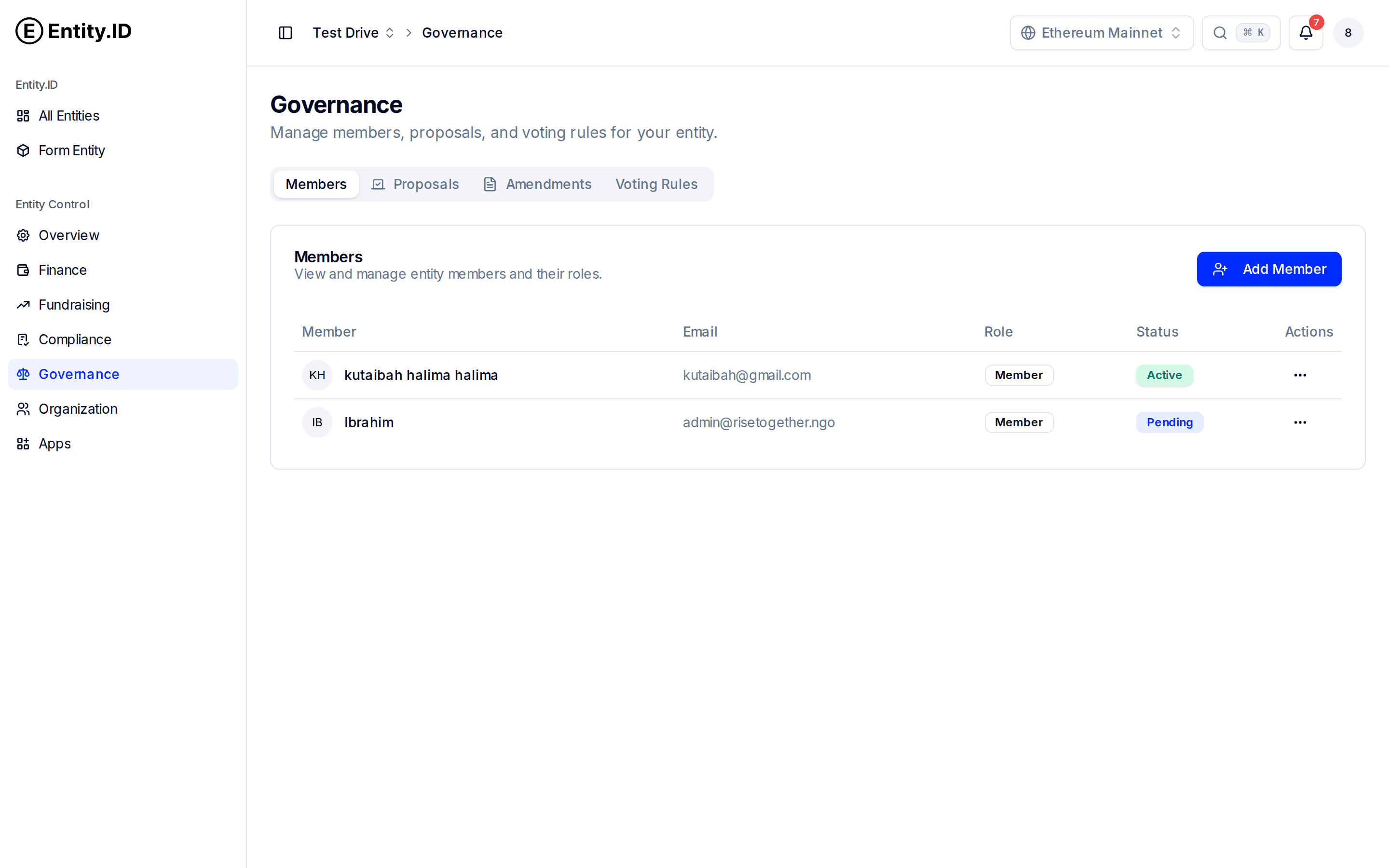
The four tabs
| Tab | What it does |
|---|---|
| Members | Who's in the venture, their role, and their status. Add members here. |
| Proposals | Anything the venture needs to decide, put to a vote. |
| Amendments | Changes to your constitution — the heavyweight decisions. |
| Voting Rules | The thresholds that decide when a proposal passes. |
Proposals and votes
Any member can raise a proposal: spend from the treasury above a limit, change the ownership split, bring in a new partner, adopt a budget. Members vote, the voting rules from your constitution decide the outcome, and the decision is recorded — who proposed, who voted which way, and when it passed.
Your constitution sets the defaults: what needs a simple majority, what needs a supermajority, and what needs unanimity (typically constitution amendments and ownership changes).
Roles: members, directors, controllers
Not every decision should need a vote. You can configure roles so day-to-day operations stay fast:
- Members — the owners. They vote on proposals and amendments.
- Directors — members given authority to act for the venture in a defined area (for example, signing contracts up to a limit).
- Controllers — accounts with operational permissions, like initiating treasury payments that still need multi-approval.
The pattern that works: broad authority for small things, votes for big things, and a written rule for which is which — that rule being your voting rules, not a memory.
Why recorded decisions matter
When a dispute happens — and in half of founding teams, one eventually does — the question is always "what did we agree?" With governance on Entity.ID, the answer is a record both sides can point to instead of two conflicting memories. That's also exactly what the dispute resolution process you chose at formation will look at.